
What happens to my money if a financial app shuts down or gets hacked?
22/08/2026
Learn more


A bank statement is very good at telling you what happened. It is much less useful at showing you the pattern behind it.
You can scroll through months of transactions and recognise almost everything you bought, while still struggling to say what your normal life actually costs. Some months are expensive for obvious reasons. Some payments happen once a year. Money moves between your own accounts. Work expenses get reimbursed. Credit-card purchases appear in one place and the payment of the card appears somewhere else.
Spending DNA is MoneyAngel’s way of turning all of that activity into a clearer picture of how you actually use your money.
It looks beyond individual transactions to show how your spending behaves over time, where most of it goes, what keeps coming back and how your own pattern compares with wider UK spending.
The most useful view of your spending is rarely one month in isolation. MoneyAngel can look across up to 12 months of spending history, giving unusual months somewhere sensible to sit rather than allowing them to distort the whole picture.
You can bring that information in through connected accounts or bank statements. The important part is that MoneyAngel is working from real transactions rather than asking you to estimate what you think you normally spend.
That sounds like a small difference, but most of us are not particularly good at remembering the ordinary stuff. We remember the £600 car repair. We are less likely to remember every supermarket trip, takeaway, train ticket, Amazon order or subscription renewal that happened around it.
MoneyAngel also needs to distinguish between spending and money that simply moved.
If £400 goes from your current account into your savings account, you are £400 down in one account but you have not spent £400. The same applies when you transfer money between your own accounts or pay a credit-card bill for purchases that are already included elsewhere.
Refundable expenses can create a similar problem. If you pay £120 for a work hotel on your own card and your employer pays you back, treating the £120 as part of your normal household spending would give you the wrong picture.
Spending DNA is designed to remove those kinds of distortions so the totals are based on money that has genuinely gone towards your spending.
With statement uploads, the transaction amounts themselves are captured down to the pounds and pence shown on the statement. Categorising them is a different challenge. A merchant name does not always make it obvious whether something was groceries, transport, entertainment or something else, so MoneyAngel lets you review how transactions have been classified rather than pretending automation can always know perfectly.
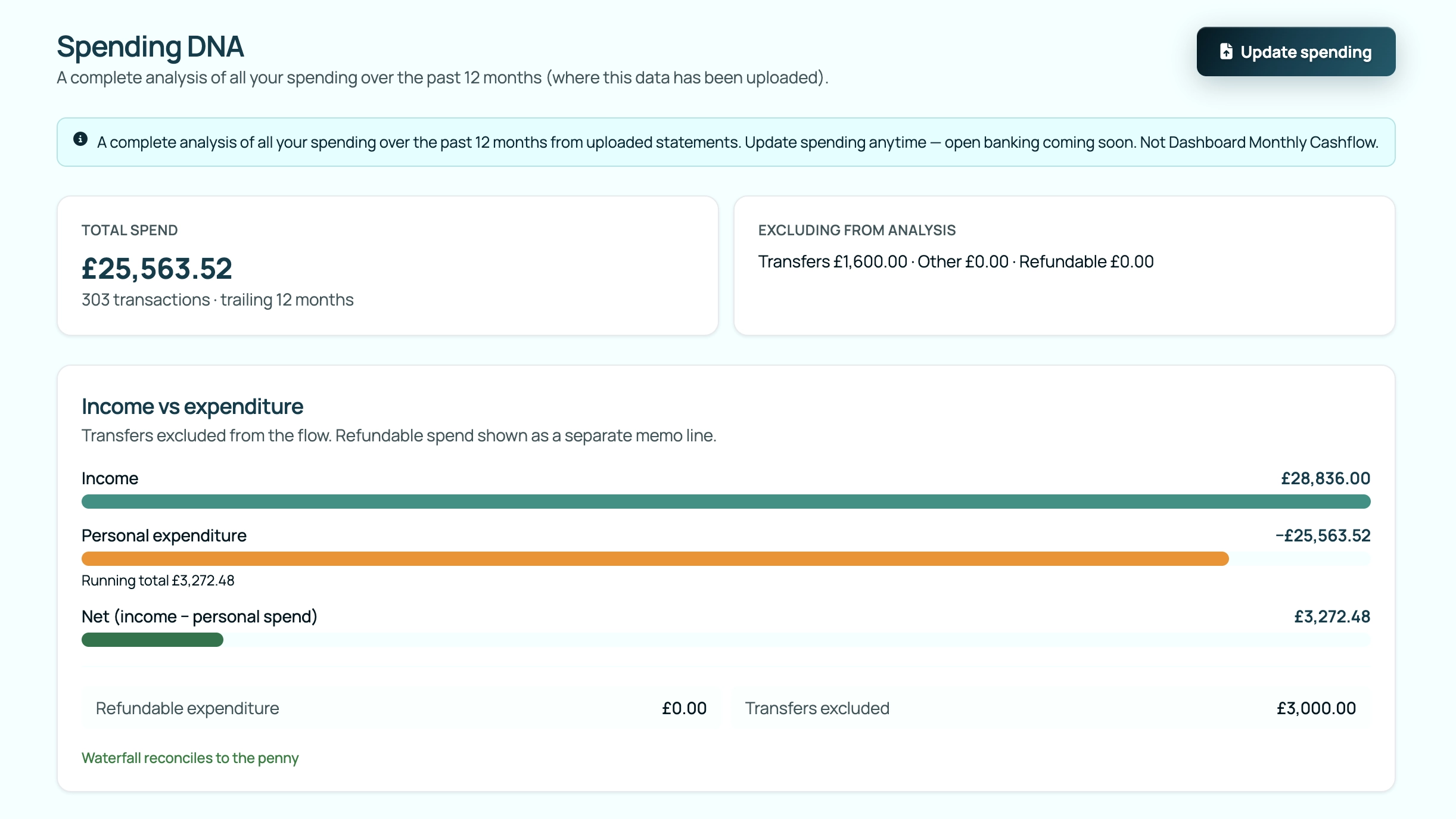
MoneyAngel Spending DNA brings together up to 12 months of spending, separates transfers and excluded transactions,
and shows how your income and personal expenditure compare.
Once the transactions are brought together, Spending DNA can show what has been happening month by month and across different areas of your spending.
You might already know roughly what you spend on food, for example. Seeing a year together can tell you whether that figure is actually stable, whether it has gradually increased or whether a couple of unusual months are changing your impression of it.
The same applies to recurring payments. One £8 subscription rarely feels important when it leaves your account. Five or six of them, alongside insurance, memberships, software, streaming services and other regular payments, can become a meaningful part of the month.
You can also move beyond the broad categories and look at what is underneath them. “Transport” on its own does not tell you very much if it includes petrol, parking, trains and car costs. “Borrowing” becomes more useful when you can see the different payments contributing to it.
None of this means a category is automatically too high or too low. The point is to understand your own pattern before deciding whether you want to change it.
MoneyAngel can also place parts of your spending alongside UK averages. That is useful as context, not as a target. Spending more than average on one area may be completely reasonable for your household, where you live or the things you care about. What matters is that you can see the difference and decide whether it tells you anything useful.
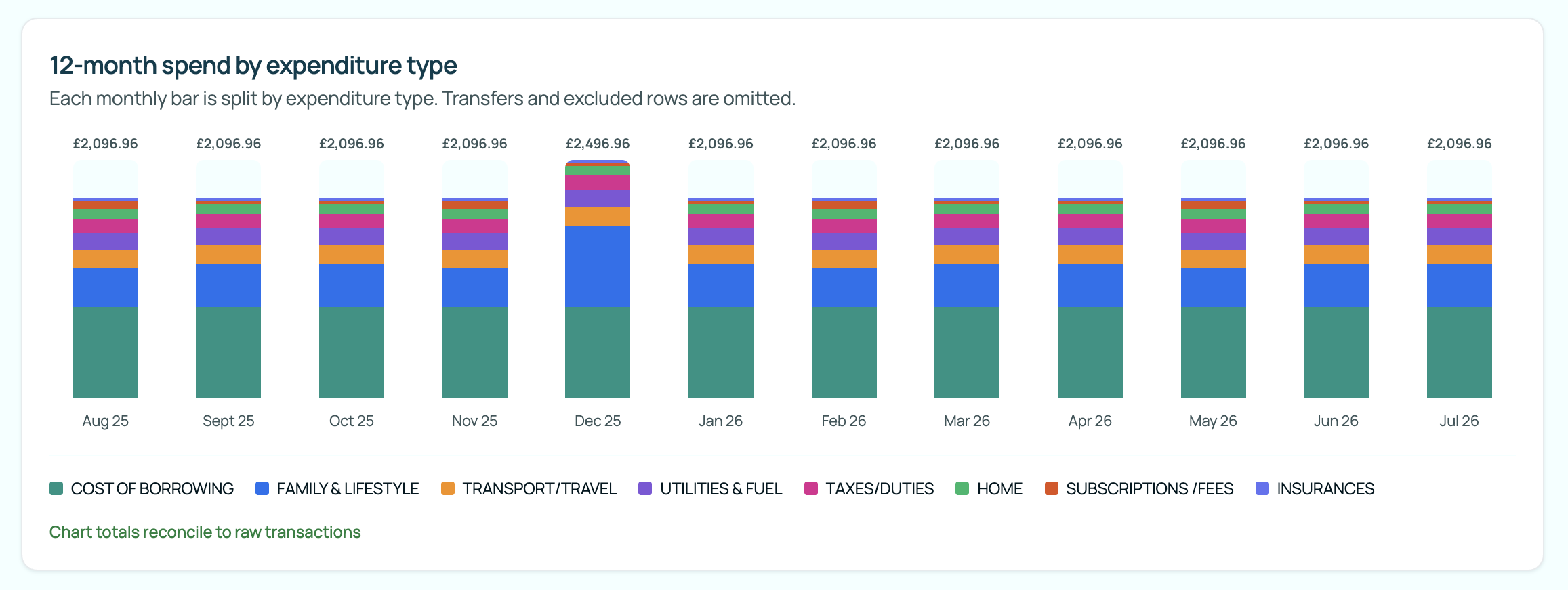
A 12-month view makes it easier to see which parts of your spending stay consistent, which change over time and where an unusual month stands out from the wider pattern.
A spending tracker can tell you that you spent £2,300 last month and leave you there.
Spending DNA is more useful when that information becomes part of the rest of your MoneyAngel picture.
If you can see what your normal life costs, you have a much better starting point for building a budget that is based on reality rather than good intentions. You can see which costs are fairly fixed, which ones move around and where there may be room to make different choices if you want to.
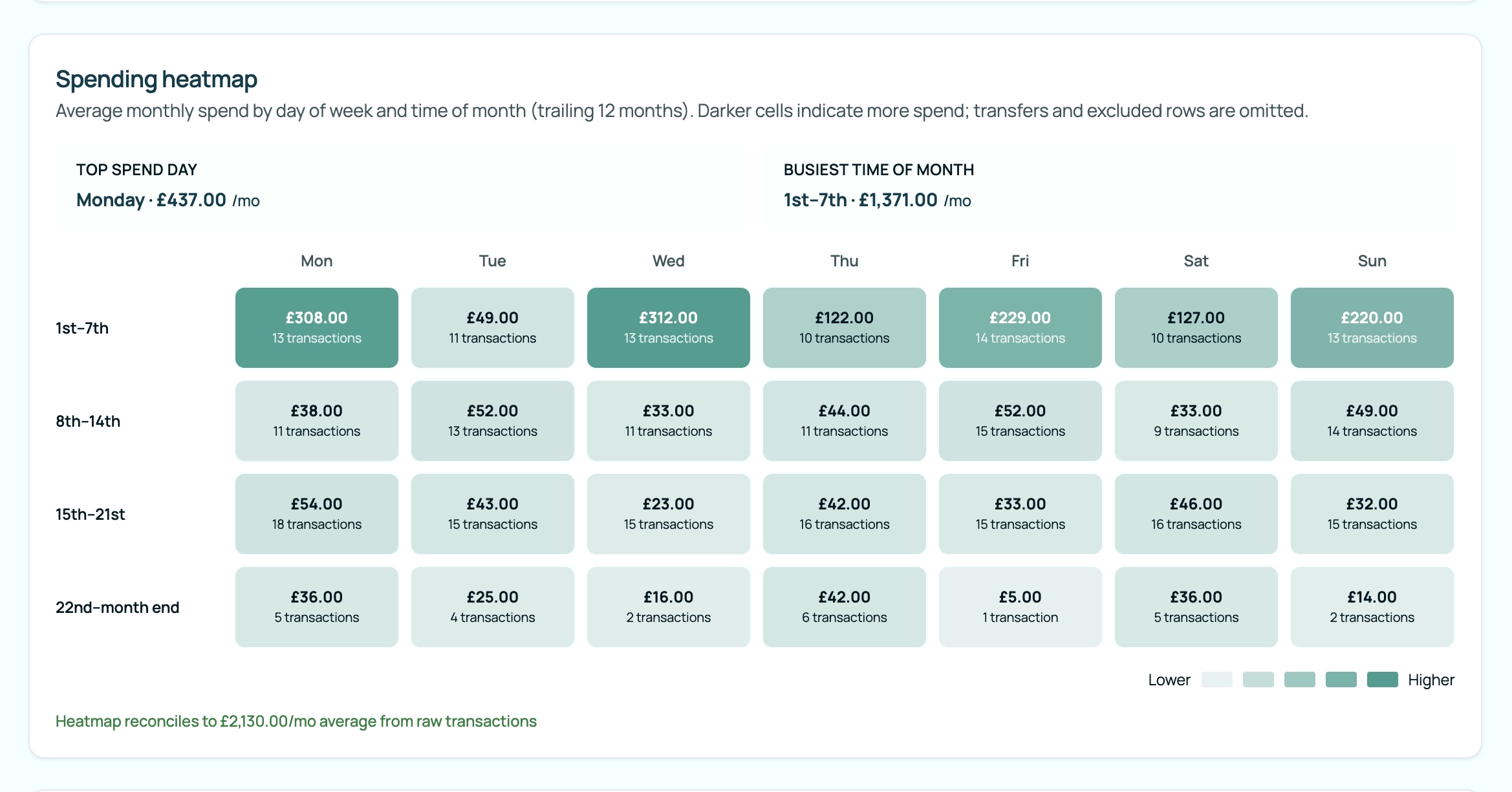
Spending DNA can also show when spending tends to happen, helping reveal patterns across different days and parts of the month that are difficult to spot from individual transactions.
That budget then matters beyond the next month. The amount you regularly spend affects what you are able to save. What you save affects the goals you are working towards and how your wider financial position develops over time.
So Spending DNA is not there to inspect every purchase or judge how much you spent.
It is there to answer a more useful question. What does the way I actually spend my money look like when I can see all of it properly?
Once you know that, you can decide whether you are happy with it, what you might want to change and what those choices could mean elsewhere in your finances.
None of that comes from guesswork, though. It only becomes real once your own accounts or statements are in MoneyAngel and there is a genuine 12 months for Spending DNA to work with. The version of this in your head is a rough estimate. The version MoneyAngel builds is based on what you actually spent.
This article is for general information only and is not financial advice. It does not take account of your individual needs, objectives or circumstances. If you need advice about your own situation, speak to a suitably qualified professional.









Whether you’re saving for a key milestone, planning for your future or simply trying to feel more in control, MoneyAngel helps you ask better questions and get clearer answers.

Have a question about our upcoming launch, or just want to know a bit more about how MoneyAngel works? Send us a message below and we’ll get back to you soon.
No spam. Just launch news and the occasional useful update. Unsubscribe any time.